

Resource Center
Designed and curated by clinicians, professionals, and fellow young people, these resources are here to support life’s challenging moments.
College guides
For years, college was the goal. Now that you’re there, the pressure shifts. These guides give you the practical skills and agency to find your footing and make the most of college.
-
![]()
High school graduation marks more than an academic milestone; it’s the first step into young adulthood.
DOWNLOAD -
![]()
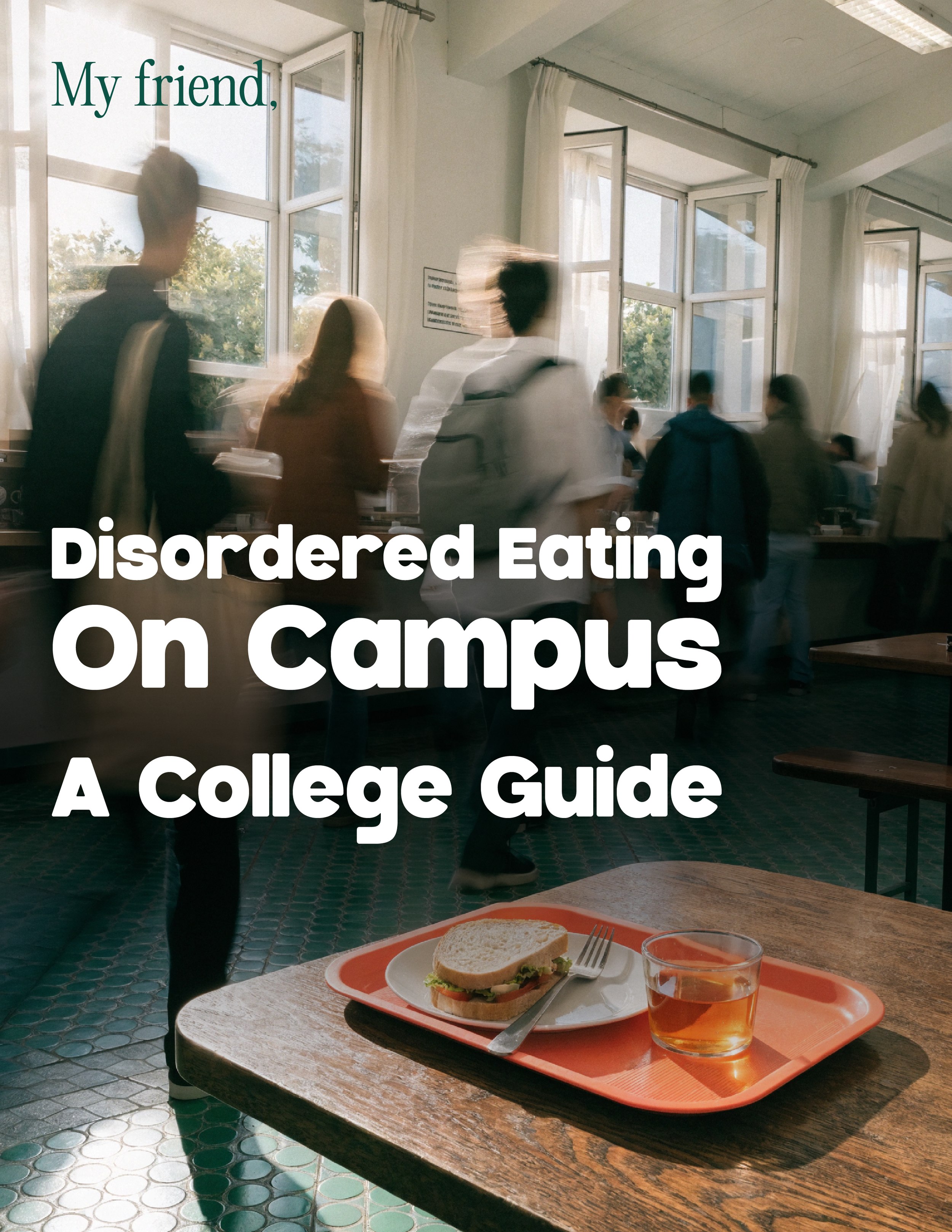
A practical guide to navigating disordered eating in college, with actionable resources for students, families and professionals.
DOWNLOAD -
![]()
Designed to support the academic success, mental health, and social transition of students throughout their collegiate journey.
DOWNLOAD -
![]()
Expert guidance for students and parents hoping to navigate the holiday season with connection and understanding.
DOWNLOAD



When your heart is racing and your thoughts won’t slow down, knowing how to take a step back can make all the difference. Practice these research-backed tools to ground yourself, calm your nervous system, and get back to feeling like yourself.
Take a moment for you
-
PMR helps signal to your body that it’s safe to relax. This is the perfect technique to try before bed, after exams, or anytime you need to unwind.
Find a comfortable position (you can be sitting or lying down).
Starting at your feet, tense the muscles (curl your toes, flex your feet) for about 5 seconds, then release and notice the difference.
Move slowly up your body: legs, stomach, shoulders, arms, hands, jaw, and face. Tense each group for 5 seconds, then relax for 10.
Breathe deeply throughout, noticing how your body feels heavier and calmer with each release.
-
When you start to feel anxious or overwhelmed, try this simple 5-step exercise. In your mind, identify:
5 Things You Can See: Look around and name five things in your environment such as a person walking by, a book, a plant, a light, or your shoes.
4 Things You Can Touch: Notice four things you can physically feel. The texture of your shirt, the chair beneath you, a pen in your hand, or your feet on the floor.
3 Things You Can Hear: Focus on three sounds around you: the hum of a heater, people talking, or your own breathing.
2 Things You Can Smell: Identify two scents. The smell of fresh air, or a cup of tea.
1 Thing You Can Taste: Focus on one taste such as mint gum, water, or a snack.
-
Think of it as the 4 - 4 - 4 - 4 method—each side of the square represents 4 seconds. Focus on the cycle of air moving through your body as you trace your finger along each edge.
Inhale slowly through your nose for 4 seconds and imagine tracing the first side of a square.
Hold your breath for 4 seconds and trace the next side of the square.
Exhale gently through your mouth for 4 seconds: that’s the third side.
Hold again for 4 seconds before starting over and completing the square.
Repeat this pattern 3–5 times, or until you feel more centered and relaxed.
-
A useful skill for changing our body’s reaction to distress. It can quickly help us regulate so that we can respond calmly instead of reactively.
T - Temperature: To calm down immediately.
Apply an ice pack or something frozen to your face or wrists.
Lean forward, hold your breath for up to 30 seconds.
Cold water on your face works too.
I - Intense Exercise: To release built-up energy.
Engage in intense exercise for a short burst of time.
The goal is to expend your body's stored energy.
Stim dancing counts — whatever moves your body!
P - Paced Breathing: To slow down your nervous system.
Breathe in for 4 seconds, hold for 4, breathe out for 4.
Find the pace that works for you (3-5-7 works great too).
P - Progressive Muscle Relaxation: To release tension in your body.
Work through one section of your body at a time.
Breathe in and tense your muscles. Breathe out and release.

Crisis textlines
The Trevor Project
+1 866-488-7386
Trans Lifeline
+1 877-565-8860
988 Suicide + Crisis Lifeline
Text 988
Teen Line
+1 800-852-8336
LGBT National Youth Talkline
+1 800-246-7743
Crisis Text Line US
Text HOME to 741741
Crisis Text Line Canada
Text 686868
If this is an emergency or you're having thoughts of self-harm, please call or text 988 to get immediate crisis support.
-
You'll be connected with a trained crisis counselor who will listen, ask how you're doing and whether you're safe, and work with you to understand what kind of support you need in the moment. You'll first hear a short message with options like Veterans support or Spanish-language services, then be connected with a counselor. The conversation is confidential and judgment-free, with the goal of helping you feel safer and more supported.
-
Not exactly anonymous, but confidential.
You don't have to share your name or other identifying details to get support, but confidential and anonymous aren't quite the same thing. Counselors will typically know the number you're calling or texting from, but typically won’t share information unless there's an immediate safety concern, like a risk to your life or someone else's. -
Yes. Calls, texts, and chats with the 988 Lifeline are free.
-
The goal of crisis text lines is to de-escalate situations and to talk with the caller to identify the best options for seeking help near them
Emergency services are generally contacted only when there is an imminent or ongoing risk of harm to you or someone else and a less-invasive safety plan can't be developed together. -
Your feelings are real and deserve to be taken seriously. If talking to family isn’t possible, consider reaching out to another trusted adult who makes you feel heard and seen. Seeking support doesn’t mean rejecting your family or culture, but that you are taking care of yourself.
-
You do not need to be in danger or at the risk of self-harm to use a crisis line. You also do not have to compare your pain to others, as talking about things early can prevent feelings from escalating.
-
Talking to friends can be a great first step, but friends aren’t expected to have all the answers or know how to handle every situation. Consider reaching out to a trusted adult or mental health professional when you need more support.
-
Many teens fear being seen as “weak” or “dramatic” if they ask for help. In reality, reaching out is a sign of courage, and not weakness.
Your thoughts & questions, answered
Need more support?
If things are feeling bigger than what you can handle on your own, you don't have to figure it out alone. Explore expert guidance on navigating treatment, finding the right level of care, and accessing our scholarship program.